
an 11-metre-high internal atrium inside a contemporary London corporate office building

Cleaning Atrium and Internal High-Level Glazing Above an Occupied Office Floor

Window Cleaning Buzz

A facilities manager on Fenchurch Avenue asked me to quote an eleven-metre atrium with a glazed roof, four glazed bridge balustrades and a full-height internal screen, and told me in the same breath that the trading floor underneath could not be closed at any point. Not for an hour, not on a Saturday, not for the machine to be walked in. He wanted the whole thing cleaned around a working room. I’ve had versions of that conversation in maybe thirty buildings across the City and Docklands, and it always comes down to the same question: what happens when something falls on a live floor.

Can this work be done while people are underneath?

No. That’s the entire answer, and everything else is a discussion about how you arrange the building so that people aren’t.

Anything held above a person’s head at eleven metres will eventually be dropped by somebody. A squeegee channel, a wing nut off a pole clamp, a bottle of detergent, a mobile phone out of a chest pocket. The physics of a 200-gram object falling three storeys onto a scalp are not negotiable, and no amount of tool tethering brings the residual risk down to something you’d accept over a desk that’s occupied.

There’s a middle route that works in some buildings, and it’s zoning by time rather than by area. Half the atrium on one Sunday, half on the next, with the affected desks stripped of monitors and covered on the Friday evening by the client’s own team. It doubles the mobilisation cost and it keeps the floor working through the week, which for a trading operation is the only variable that matters. I’ve run it on a Stratford building off Montfichet Road across three weekends and the total bill came in under what a full weekday closure would have cost the client in lost seats.

The drop zone nobody wants to give you

An exclusion zone under a MEWP isn’t the machine’s footprint. It’s the working envelope plus a margin for anything that leaves the platform and bounces, which on a hard floor with glass overhead means considerably more than people expect – I work to a radius of roughly half the working height, extended in the direction of any sloped glazing that could deflect something sideways.

On a floor plate laid out at six desks to a bay, that swallows a whole zone. The FM’s instinct is to negotiate it down to a couple of barriers and a banksman. Mine is to move the desks or move the work to a Sunday, and I’ve walked away from two jobs where the client wouldn’t do either. Neither building has had its atrium glass touched since, which tells you what happened next: somebody quoted it without the exclusion zone.

Will the floor take the machine?

Ask before you promise anything, because the honest answer on a refurbished London office is often no.

Internal MEWPs get chosen for reach and forgotten for weight. A push-around vertical mast lift with a decent platform height sits comfortably over 400 kilos before an operative and water get on board. A self-propelled scissor with the same reach can be double that. All of it arrives through point loads under four small wheels.

Raised access floors and what they’ll bear

Most City offices sit on a raised access floor – 600mm panels on adjustable pedestals, with a stated point load rating that a lot of buildings can no longer evidence because the original submittals went missing in the second refit. A panel designed for office loading will take a person and a desk without complaint. It will not take a concentrated wheel load from a lift machine unless somebody has calculated it.

The fix is spreader plates, and on a live floor they go down before the machine moves an inch. Timber or aluminium sheets under the wheels distributing load across several panels and pedestals, laid out with the machine’s travel path planned in advance rather than improvised while it’s moving. Pedestals fail at the head, and a collapsed panel with a machine on it goes from a scheduling problem to a rescue in about a second and a half.

There’s also the void beneath. Data cabling, chilled water pipework, sometimes a fire suppression main. A pedestal punching through a chilled water pipe on a Sunday morning in Bunhill Row cost a client of mine two days of remediation and a very awkward insurance conversation, and the machine was within its rating on paper. The load had been checked. The route hadn’t.

Where the atrium floor is a solid slab with a stone or terrazzo finish, the loading is usually fine and the concern shifts to marking. Non-marking tyres, clean wheels, a walked route with the floor swept first. Grit trapped under a wheel scores polished stone in a straight line that stays visible for the life of the finish, and that repair costs more than the contract.

How does a machine get into the building at all?

This kills more jobs than floor loading does, and it comes up at the worst possible moment, usually on the morning of the works.

Goods lifts in central London buildings were sized for furniture and catering trolleys. A machine reaching eleven metres is long, and it’s long in the dimension that matters – the diagonal on the lift car floor. Measure the car, measure the doorway, then measure the lobby outside the lift on the arrival floor, because a machine that fits the car and can’t turn out of it has achieved nothing.

Building it in place

Some machines come apart. Certain low-level access towers and mast lifts split into modules that pass through a standard door and reassemble on the floor, which is often the only viable route in a building with an undersized lift. Reassembly needs to be done by someone competent and it needs to be recorded, since a machine put back together wrongly is a lifting appliance with a person on it.

The alternative is an aluminium tower, and I use them more than the trade admits. On a low-rise atrium at Chiswick Park a PASMA-built tower with a proper base and outriggers did the work faster than a hired scissor would have, cost a fraction, and left no marks on the floor. It’s slow to reposition, which is why contractors dislike it, and it’s fine when you’ve already accepted the floor will be closed for the day.

Rope access from roof-level anchors is the other option for tall atria, and it’s an elegant answer where the anchors exist and have current certification. They rarely do in buildings completed before about 2010.

What paperwork does the building require before you start?

More than the cleaning warrants, and the fire systems are where people come unstuck.

Working at eleven metres inside an atrium puts an operative and a wet brush next to smoke detector heads. Water vapour and dust set them off, and a full evacuation of an office building at nine on a Sunday morning brings out the fire brigade, the security manager and a bill. Detector isolation has to be arranged through the building’s fire system contractor, logged, and reinstated before anyone leaves – and while a zone is isolated, someone has to be walking it.

The permit stack

Hot works permits are irrelevant here, but almost everything else applies: a work at height permit, a lift permit if a MEWP is used, an out-of-hours permit, security clearance and DBS checks for operatives on some financial floors, and a rescue plan naming who retrieves an operative from a stranded platform and how.

The rescue plan is the one that gets copied from a template and never read. A machine that stops with someone at eleven metres over an atrium void is not a problem the building’s own team can solve at two in the morning. My method statement names the ground-level emergency lowering controls, names the person trained to use them, and puts that person on site for the duration. That means two operatives minimum on any powered access job, which is a cost, and it’s the cost that separates a proper price from the one that undercuts it.

How often does internal glazing warrant all this?

Far less often than the specification says, and here I’ll argue against my own invoice. Annual is right for most atrium roofs. Two-yearly is defensible on internal screens and bridge balustrades in a building with decent air handling.

Internal glass soils slowly and differently. There’s no traffic film, no rain-driven dirt, no pigeon problem. What lands is fine dust circulated by the HVAC, textile fibre off carpets and soft furnishings, and a greasy haze near catering areas that comes off cooking aerosols and hand contact at low level. Above three metres, hand contact stops mattering entirely and the accumulation rate collapses.

What the light tells you

The trigger should be the light, not the calendar. An atrium roof with a shallow pitch collects dust on the inner face and dulls the daylight reaching the floor plate below, and the first person to notice is usually somebody complaining that the office feels gloomy in February.

I told a client on Wellesley Road in Croydon that their quarterly internal spec was pointless and that two visits a year would look identical. They cut it, kept me, and spent part of the saving on the atrium roof they’d been ignoring for six years – which was the piece costing them daylight. That job took a Sunday, a scissor lift, four sheets of spreader ply, and an isolation certificate that took longer to arrange than the cleaning took to complete.

Nobody upstairs noticed on the Monday, which is the point. The glass is meant to be invisible on a live floor.

What To Do When Balcony Glass Balustrades Can Only Be Cleaned From Inside the Flat

Window Cleaning Buzz

The managing agent for a block off Marsh Wall in E14 sent me a specification last autumn that ran to nine pages and mentioned internal access exactly once, in a subclause, as something the contractor “may need to arrange”. Eighty-four flats. Frameless glass balustrades on every balcony, top-fixed into a stainless base shoe, no maintenance access from the roof and no eyebolts anywhere on the building. The outer faces of those panels had been visibly filthy since handover in 2019 and every contractor before me had priced the job as though a pole from the podium would reach the tenth floor. That’s the job nobody wants to explain to a board of directors, so it keeps getting quoted as though the problem isn’t there.

Why can’t these panels be reached from outside?

Geometry, mostly. A glass balustrade sits at the outer edge of a slab that projects past the building line, so the outer face of the panel is the furthest point on the whole elevation from anything you could stand on. A water-fed pole works up to about the fourth floor in still air on a good day, and it works by reaching up a flat facade. It has nothing to push against once the balcony overhangs.

Above that you’re into a mobile elevating work platform, a cradle, or rope access. All three exist. All three cost money that a service charge budget written in 2018 never contained.

What changed in the design

Older London blocks used solid balustrades or steel railings, both of which look tolerable when dirty. Glass doesn’t. A frameless panel is a design feature meant to disappear, and a disappearing feature that has gone grey draws the eye harder than a painted rail ever did.

Then there’s the base shoe. The stainless channel gripping the bottom of the panel collects water, grit, cigarette ends and the fine dust that comes off every construction site within half a mile. It drains poorly on a lot of installations. Left long enough it stains the glass edge and corrodes the fixings, and by the time anyone notices, the conversation has moved from cleaning to remediation.

Is it lawful to lean over the balustrade and reach down?

You can. I won’t, and I’d argue nobody should be pricing work on the basis that their operatives will.

Reaching over a 1,100mm barrier to clean the face below puts a person’s centre of gravity outside the building with a drop underneath, which is work at height by any reading of the Regulations. The barrier itself is designed to BS 6180 to resist a horizontal line load from people leaning against it. Nothing about that specification anticipates a fifteen-stone operative putting his hips over the top rail while both hands are occupied with a squeegee and a bucket.

The anchor point that isn’t there

Ask a building manager where the eyebolts are and watch the pause. Most residential blocks completed in the last fifteen years have no certified anchor points on balconies at all, because nobody in the design team was made responsible for cleaning the thing they were drawing.

A balustrade fixing is not an anchor. It has never been tested as one, it has no inspection regime under any lifting or fall arrest standard, and a base shoe grouted into a slab edge in wet weather on a Friday afternoon is not something I’d hang a person from. Operatives do it anyway across London every week, tied to a handrail with a lanyard that would swing them into the slab below if it ever took a load. That’s the job as performed on a lot of blocks, and it will keep being performed that way until it kills somebody at Nine Elms and everyone rediscovers their duties.

Who has the right to get into the flat?

The lease decides, and most leases are on the freeholder’s side. A standard residential long lease reserves a right for the landlord and their agents to enter the demised premises on reasonable notice to inspect, repair and maintain the structure and common parts, and the balustrade panel is almost always retained structure rather than demised to the leaseholder. Forty-eight hours’ written notice is the common formulation. Some leases say twenty-four.

That right exists on paper. Exercising it across eighty-four flats on the same Tuesday is a different exercise altogether.

What stops the work happening

Refusals are rare and mostly reasonable. Night shift workers, new babies, someone shielding, a subtenant who was never told and won’t open the door to a stranger in a branded fleece. The real killers are subletting and voids: a flat let on an assured shorthold through an agent who doesn’t answer emails, or an overseas owner whose only UK contact is a management company in Jersey.

On a block near Ponton Road in SW8 we got into 71 of 96 flats on the first pass, 14 more on a Saturday afternoon revisit, and never got into the remaining 11 at all. Those balconies are still dirty. The board’s answer was to publish a photograph of the elevation in the newsletter with the unclean panels obvious, which is the most effective access tool I’ve seen anyone use. Peer pressure beats a legal letter every time and costs nothing.

Notice needs to come from the agent, on the agent’s letterhead, with a date and a two-hour window per flat. A contractor knocking cold gets nowhere and deserves to.

How do you clean a balustrade panel from inside a flat?

Carefully, and with more kit than the job appears to need. The panel’s outer face has to be reached over the top edge, so the working method is a short-reach pole with a swivel head, or a hand-held applicator on an extension handle where the balcony depth allows a person to stand on it and work over the rail without leaning.

Water control governs everything. There is a flat below. Water that runs off the bottom edge of the panel lands on somebody’s furniture, and one soaked sofa on the fourth floor costs more than the entire elevation’s cleaning fee. I work with a low-flow rinse, a microfibre-sleeved applicator carrying most of the solution, and a channel squeegee finishing bottom-up so the residue runs back onto the balcony rather than over the edge.

The sequence I use on an occupied flat

Shoe covers and a runner from the front door to the balcony door before anything else, because these flats are almost always carpeted or engineered oak and a wet bootprint in a hallway ends the relationship with the resident and the agent in one go. Then a look at the balcony floor – composite decking, usually, sometimes tile – and a check for standing water in the base shoe drainage.

Detergent stage on the outer face, dwell, agitate, rinse with deionised water applied sparingly. The inner face gets done at the same visit because the resident will ask, and refusing on the grounds that the specification says outer faces only is technically correct and commercially stupid.

Then the base shoe. Vacuum it, flush it, tell the agent in writing what came out of it. On a Colindale block off Aerodrome Road I pulled enough compacted grit and moss out of the channels to fill two buckets across one elevation, along with a screw that had corroded through. That went in the report. The remediation contract that followed was worth more than three years of cleaning.

Wind is the last variable and the one that ruins schedules. Anything above the twelfth floor on a river-facing block gets a wind speed above what makes fine work possible for a good part of the year, and the honest thing is to build float into the programme rather than promise dates you’ll break.

How should a block budget for this?

Twice a year for outer faces on a tall block, and I’ll defend that against anyone selling quarterly. The internal access burden is the expensive part, not the cleaning, and the marginal appearance gain from four visits over two doesn’t justify putting a stranger into eighty-four homes twice more each year.

Where the money goes

Price it as an access job with a cleaning component attached. Notice letters, a concierge or porter escorted throughout, two operatives so nobody is alone in an occupied flat, a revisit day for missed access, and a written record per flat with time in and out.

The alternative is a MEWP or rope access from outside, and there are blocks where that’s cheaper – low-rise, good hardstanding, no podium deck with a loading limit underneath. Nine floors up on a site with a basement car park below the forecourt, the platform can’t come and the answer is the front door.

Developers keep specifying frameless glass on buildings with no external access provision whatsoever, and the maintenance cost of that decision lands on leaseholders who had no say in it. A cradle track, a set of certified eyebolts on each balcony, or a slab edge detail that lets a pole reach the outer face would each add a modest amount to a build budget and remove a permanent problem. None of them get drawn, because the person specifying the balustrade is not the person who will be knocking on eighty-four doors in year six.

So the flats are the access route, and the whole thing becomes a scheduling exercise dressed up as window cleaning. Letters, keys, escorts, revisits, a spreadsheet with a row per home. That’s the job.

The base shoe on the Marsh Wall block will need stripping and resealing within five years. Nobody has budgeted for that either.

Traffic Film, Diesel Soot and Why Glass Greys Faster on Euston Road Than in Muswell Hill

Window Cleaning Buzz

Two jobs, same week, same equipment, same operative. A run of first-floor offices above the shops on the Euston Road side of Warren Street, and a detached house on Fortis Green Road in N10. The Euston Road glass had been cleaned nine weeks earlier and looked, from the pavement, as though nobody had touched it since the spring. The Muswell Hill glass had gone four months and needed the work far less. Clients see that difference and assume somebody skimped. What they’re looking at is a film with a chemistry all of its own, laid down at a rate that has almost nothing to do with how well the last clean was done.

What is traffic film made of?

Soot, but soot is the smallest part of it now. Diesel exhaust particulate has fallen steadily across London since the low emission zones went London-wide, and the greying has not fallen with it. The material coating the glass on any arterial route is mostly non-exhaust: brake wear, tyre wear, road surface abrasion and the constant resuspension of everything that has already landed and been kicked back into the air by the next bus.

Brake dust is metallic. Iron, copper, antimony, ground off the pads and discs at every set of lights, which on the Euston Road means roughly every 200 metres between Marylebone and King’s Cross. Tyre wear contributes polymers, fillers and silica. Road abrasion adds mineral dust. Blend the lot with hydrocarbon residue and the diesel soot that’s still there, and you have a film that behaves less like dust and more like a thin, greasy varnish.

Why the binder matters more than the dirt

Dust falls off. Dust rinses. The reason traffic film survives London rain on a vertical pane is the oily fraction holding it to the surface – unburnt hydrocarbons and organics from tyre polymer that bind the particulate into a continuous layer rather than a scatter of separate specks.

That continuity is what the eye reads as grey. Individual particles at that size are invisible from three metres. A bound film across the whole pane scatters light evenly and drops the apparent clarity of the glass before anyone can point to a single mark on it. Customers describe it as the window looking “tired” or “misted”, and half of them are convinced the double glazing has failed.

Why does Euston Road grey glass faster than Fortis Green Road?

Volume, stop-start braking and the shape of the street. Muswell Hill sits high, has no through route of any consequence, and the traffic that does pass moves at a steady speed with light braking. Fewer vehicles, less brake material, better dispersion.

Euston Road is a canyon. Buildings both sides, six lanes, and a queue that stops and starts from seven in the morning until well after seven at night. Vertical mixing is poor between the facades, so the material rises, hangs and settles on whatever’s nearest. And it shows.

Why the first floor suffers worse than the fourth

The gradient is steep and most people underestimate it. Coarse non-exhaust particulate is heavy and doesn’t travel far vertically before it comes back down, which loads the lower two storeys of any roadside building far harder than the upper ones. On a seven-storey block on Talgarth Road in W14 I cleaned for years, the second-floor glass needed monthly attention to hold its appearance and the sixth floor held up for a quarter with no argument from anyone.

Splash matters too. Wheel spray off a wet carriageway throws a slurry of road dust and rubber directly onto ground-floor shopfronts, which is why the bottom 600mm of a retail frontage on any red route goes streaky within days. Nobody has ever thanked me for explaining this to them mid-invoice.

Can pure water alone shift traffic film?

Here I’ll part company with a good deal of the trade. Deionised water through a water-fed pole is superb at what it’s designed for – loosening soluble soiling, carrying it away, drying spotless because there’s nothing dissolved in it to leave behind. Against a bound hydrocarbon film it underperforms, and every operator working the A501, the A4 or the Old Kent Road knows it even when their marketing says otherwise.

Pure water is aggressive towards dissolved solids. It has no meaningful action on grease. Brushing harder doesn’t fix that; it burnishes the film, moves some of it, and leaves a pane that looks acceptable wet and grey again forty minutes later when it dries. The operative gets blamed. The chemistry was never on his side.

What I use on arterial frontages

A detergent stage first, then the pure water. Traffic film remover of the sort the vehicle trade has used for decades is alkaline and surfactant-heavy, and it does exactly what the name says, though the strengths sold for lorry washing are too harsh for use near anodised frames and powder-coated aluminium. I dilute well below the drum’s recommendation, apply through a low-pressure sprayer or an applicator on a shorter pole, give it two or three minutes of dwell without letting it dry, agitate, then rinse the entire elevation down with deionised water and finish as normal.

The dwell is the part everyone skips. Surfactants need contact time to lift an oily binder off silica, and a contractor working to a fifteen-minute-per-elevation rate will spray and scrub straight away, which achieves very little beyond wetting the dirt. On a bank frontage near Jamaica Road in SE16 I timed the difference across two visits: same product, same dilution, three minutes of dwell against thirty seconds, and the longer dwell held its finish for close to double the interval. It costs a few minutes. It saves a return visit.

Order matters as much as product. Detergent first and rinse second, never the reverse, because pure water applied over a partially dissolved film picks up the surfactant and drags a grey slurry down the pane and across the frame below. Work top down through the elevation, keep the rinse generous, and accept that an arterial frontage uses roughly half again as much water as a residential job of the same glass area.

The other thing worth changing on these buildings is the brush. A softer flocked head holds more solution against the glass during dwell, and it drags less of the abrasive grit across the surface, which on a road throwing off mineral dust and brake particulate is a real consideration rather than a theoretical one. Stiff bristle plus silica plus pressure is how fine scratching starts.

There’s a caveat about frames. Alkaline products and untreated aluminium have a poor relationship, and I’ve seen a spotter panel go milky where somebody used neat TFR on a shop front. Test somewhere unimportant, rinse thoroughly, and don’t let the stuff dry on anything.

When does the grey stop coming off?

At some point the film stops being a film. Iron particles sitting in a damp layer against glass corrode, and corroding iron produces compounds that bond to the silica surface rather than resting on it. Give that a few years on an unwashed roadside pane and the greying is in the glass.

You can see it once you know the sign – the pane stays faintly hazy when wet, which is the opposite of what dirt does. Wet dirt goes dark and transparent. Bonded staining stays dull under water.

The conversation nobody wants to have

At that stage the honest answer is that cleaning won’t recover it. Cerium oxide polishing brings a lot of it back, though it’s slow, it’s wet, and it needs care near the edges of toughened panes where uneven heat and pressure cause problems. On badly neglected commercial glass the polishing cost gets close enough to replacement that the client should be pricing both.

I lost a contract on a parade near Bounds Green Road in N11 for telling a landlord precisely that. He’d had the frontage cleaned twice a year for a decade, believed the greyness was a cleaning failure, and wanted somebody who would promise to fix it with a squeegee. Someone did promise. And it shows.

What cleaning frequency does an arterial frontage need?

Monthly on the lower two floors of anything on a red route. Fortnightly if it’s a retail frontage where appearance is the point. Six-weekly to quarterly once you’re above the third floor or a street back from the traffic.

Those intervals sound like a contractor talking his own book, so here’s the against-interest version: most of my Muswell Hill and Highgate domestic customers are on a schedule more frequent than they need, and about a third of them would notice nothing if they moved from six-weekly to eight. I’ve told several. Two took the saving and stayed with me for years afterwards.

Why frequency beats chemistry on a red route

A film that’s four weeks old comes off with detergent and water. A film that’s eight months old has begun the corrosion process and takes polishing. The window that gets cleaned twice a year on the Euston Road is being managed towards permanent damage, and it’s a false economy nobody notices until the glass is grey in January sunshine and everyone’s arguing about who let it happen.

Frequency is also the only variable a building manager controls. You can’t move the building off the A501. You can’t stop the buses braking outside. And it shows, on every pane below the third floor, in a way that no amount of clever chemistry undoes after the fact.

The Fortis Green house went eighteen weeks before its next clean and looked fine on week seventeen. The Warren Street offices were booked back in for four weeks and I’ve never once been early.

Is It Still Legal to Clean London Windows From a Ladder?

Window Cleaning Buzz

A managing agent in Croydon emailed me in March asking for written confirmation that none of my operatives would use a ladder on her block, “since they’ve been illegal for years now”. I rang her instead of replying. Twenty minutes later she understood that the ban she’d been quoting to contractors since roughly 2011 has never existed, that her own lift-and-shift clause said nothing about access method, and that the reason her rear elevation hadn’t been cleaned properly in three years was a locked side gate rather than any point of law. She was decent about it. Plenty aren’t, and the myth costs London property owners real money every year.

So has anyone ever banned window cleaning ladders?

No. Not Parliament, not the Health and Safety Executive, not the European Union in its most enthusiastic phase. The HSE has spent two decades publicly correcting this, and it still circulates in landlord forums and facilities management inductions across the capital as settled fact.

What changed in 2005 was the framing. Before then a ladder was what a window cleaner used. After the Work at Height Regulations came in, a ladder became one option among several that you have to justify choosing.

What the 2005 Regulations demand of you

The Regulations set out a hierarchy, and the hierarchy is where people get confused. First, avoid work at height altogether where it’s reasonably practicable – a telescopic water-fed pole from pavement level, or cleaning the inside face from within the room. Second, if you can’t avoid it, use an existing safe place of work such as a balcony or a proper flat-roof terrace with edge protection. Third, provide access equipment that prevents a fall. Fourth, where the risk of falling remains, minimise the distance and consequences of one.

A leaning ladder sits low in that hierarchy. Low is not banned. The duty is to plan the work, use competent people, and be able to explain why the ladder was the suitable choice for that specific window on that specific day. Duration, incidentally, doesn’t grant you an exemption – a four-minute job on a ladder attracts the same legal obligations as a fortnight on a scaffold, whatever the trade gossip says about the thirty-minute rule.

Why does the ladder ban myth refuse to die?

Because it suits too many people. That’s the uncomfortable part.

Water-fed pole systems arrived in force around the same time as the Regulations, and the commercial story wrote itself. Pure water, no ladders, insurance-friendly, safe by design. Some of the marketing was honest. A fair amount of it implied a legal prohibition that the seller knew perfectly well didn’t exist, and fifteen years of that message has bedded in.

Who finds the confusion convenient

Large contractors like it because it removes a category of work that’s awkward to supervise and awkward to price. Small operators like it in reverse – they carry the ladder, quote the job, and never write a risk assessment, on the basis that anyone who challenges them is quoting a rule that doesn’t exist anyway. Both positions are lazy. The Regulations don’t ask you to pick a side in the pole-versus-ladder argument, they ask you to think about the elevation in front of you and record what you concluded.

Insurers muddy it further. Mine doesn’t prohibit ladder work; it prices it, asks about heights, and asks whether anyone works above the second storey from a leaning ladder. That’s an underwriting position rather than a legal one, and the two get conflated constantly in tender documents. I’ve read a Greater London Authority-adjacent framework specification that referred to “the statutory ladder prohibition”. Nobody had checked. For my money, that single phrase has done more damage to sensible access planning in the capital than any accident statistic.

Which London jobs still call for a ladder?

More than the industry admits. A pole is a superb piece of kit and it handles the overwhelming majority of what I do – terraces, semis, low-rise blocks, shopfronts with clear standing room. It has limits, and London architecture finds them faster than most.

Deep rear lightwells are the obvious one. There’s a run of converted Victorian houses off Lauriston Road in E9 where the basement flat windows sit at the bottom of a well about 2.4 metres down and 900mm wide, with a cast iron grille overhead. No pole geometry reaches that. You either go down a short ladder or the glass stays dirty, and the leaseholders down there pay the same service charge as everyone above them.

Then there are rear returns behind buildings with no vehicle access. A pole system needs water, and water is heavy. On the tighter stretches of Slades Hill in Enfield, where the van can’t get past the front elevation and the hose run would cross two neighbouring gardens, hauling a 25-litre backpack system and a 9-metre pole through a side passage is not obviously safer than a properly footed ladder against a solid brick wall for two first-floor sashes. Someone has decided otherwise on paper, in an office, without ever seeing the passage.

Conservatory surrounds, too. The pole angle over a glazed roof is often impossible without dragging brush and dirty water back across the panels you’ve cleaned, and the alternative, standing on the conservatory frame, is dangerous in a way the risk assessment can’t soften.

One more category, and it’s the one that gets argued about most: bay windows on the 1930s stock out towards Pettits Lane in Romford. The pole reaches the glass fine. What it struggles with is the underside of the bay roof and the tight junction where the upper sash meets the render, because the brush head wants an angle the pole geometry won’t give you from the front garden. Half the operatives I’ve worked with will tell you that corner has never been properly cleaned by a pole on those houses, and they’re right. Three minutes on a ladder settles it, if the path underneath is sound.

Often the path isn’t sound.

The assessment I run through on site

Ground condition first, because it’s the thing that kills people. Flat, firm, not paving that rocks when you step on it, not a manhole cover, not the sloping front garden path you get on the Edwardian stock around Eastcote Road in Ruislip. Then the top bearing point – solid wall or a stand-off, never a plastic gutter, never a fragile cill. Then the angle, roughly four up to one out, which most operatives eyeball wrong when they’re tired at four o’clock on a Friday. Then the reach: if I need to move my hips outside the stiles to get the far corner of the pane, the ladder moves instead. Then duration and load, which is where a lot of theoretically legal ladder work becomes indefensible – detailing frames, scraping paint splash, anything two-handed.

If any of those come back wrong, the answer is a pole, a MEWP, or a conversation with the client about what can’t be cleaned. Sometimes it’s the third one, and telling a customer their rear elevation is unreachable at the price they want to pay is a better day’s work than pretending otherwise.

What happens after a fall in Barking?

The investigation goes looking for documents, and it goes looking for them immediately. I had a subcontractor’s operative come off a stile-damaged ladder at a shop with flats above on Longbridge Road, IG11, some years back – not my job, but I knew the firm, and I watched the aftermath closely enough to change how I run mine.

The paperwork that decides whether you’re prosecuted

Nobody asked whether ladders were permitted. They asked for the pre-use inspection record, the detailed ladder inspection log, evidence of training, the site-specific method statement, and the reasoning behind selecting a ladder over the alternatives. The firm had a generic risk assessment covering “window cleaning” with no reference to that address, no inspection log at all, and a ladder with a bent stile that had been in service for at least eight months. That’s what gets you an improvement notice or worse. The access method was never the offence.

Keep the records and the ladder becomes a defensible tool. Skip them and the ladder becomes exhibit A – along with your quotation, your invoice, and whatever you told the client about how the job would be done.

Where do I draw my own line on ladder work?

First-floor domestic and shopfront work, yes, subject to the on-site checks. Above that, no, and I’ll lose the job rather than argue it. Second-storey ladder work on London housing stock means an extension ladder at full stretch against a cill line that’s frequently rendered, frequently soft, and frequently hiding a cable run. Legal, arguably. Sensible, no.

The footing myth, which needs to die faster than the ban myth

Someone standing on the bottom rung is the weakest form of stability there is, and it’s still treated as the default answer on domestic jobs across the capital. Ground stakes, a proper stability device, tying off at the top – those work. A colleague holding the stile while checking his phone stops nothing. I’ve turned down two-man ladder arrangements on properties around Woodcote Road in Wallington where the client specifically offered a second body as the safety measure, and for my money that offer tells you more about the state of the trade’s understanding than any HSE statistic does.

The Regulations have been in force for twenty-one years now. They ask a straightforward question of anyone putting a ladder against a London window – why this, here, today? A firm that can answer it in writing is working lawfully. A firm that can’t has been getting away with it, and one wet Tuesday on a mossy path will settle the matter for them.

For my money the ladder isn’t going anywhere. Neither is the myth.

Is It Wise To Clean Your Windows During The Winter?

Window Cleaning Buzz

When winter sets in across the UK, with its damp mornings, frosty afternoons, and the occasional snow flurry, cleaning exterior windows might be the last thing on your mind. Most people assume it’s best to wait until spring when temperatures rise, and conditions are more pleasant. However, winter window cleaning does have its benefits. Clear windows allow more light into your home, making a big difference during the darker months. If you leave dirt and grime accumulating over the winter, your windows may be far harder to clean by spring. That said, winter window cleaning is not without its challenges. The weather can be unpredictable, freezing temperatures can make the task uncomfortable, and the risk of slipping on icy surfaces is real.

So, is it wise? The short answer is: it depends. If your windows need cleaning, taking the right precautions can make the job worthwhile. But if they’re not too bad, waiting for better weather might be smarter. In this article, we’ll explore whether winter window cleaning is truly necessary, the risks involved, the biggest challenges, and some professional tips to make your efforts successful. We’ll also go deeper into the impact of winter grime on windows, discuss different cleaning methods suited for cold conditions, and offer insights into whether hiring a professional is the best choice for tackling winter dirt.

Should You Clean Your Windows in Winter or Wait Until Spring?

Many homeowners and business owners prefer to schedule window cleaning in spring, assuming winter dirt isn’t a pressing issue. However, leaving your windows covered in grime for months can cause long-term damage. The combination of rain, sleet, and pollution leads to streaky, dirty windows, which can eventually affect the glass. Hard water stains, mineral deposits, and even minor scratches from accumulated debris can worsen over time if left unchecked.

Dirty windows can give businesses the wrong impression, making their premises look neglected. Winter dirt can block natural light at home, making rooms feel even gloomier than they already do during the season’s shorter days. Clean windows help maximise daylight, improving mood and even reducing energy costs by allowing more warmth inside.

On the other hand, if your windows aren’t particularly dirty and you don’t want to battle the cold, it’s not unreasonable to wait until spring. The key factor is assessing the level of dirt and whether it’s affecting visibility, light, or the condition of the glass. Leaving grime on your windows for too long can lead to stubborn stains, but if it’s a mild build-up, a thorough clean in spring might be enough to restore their clarity.

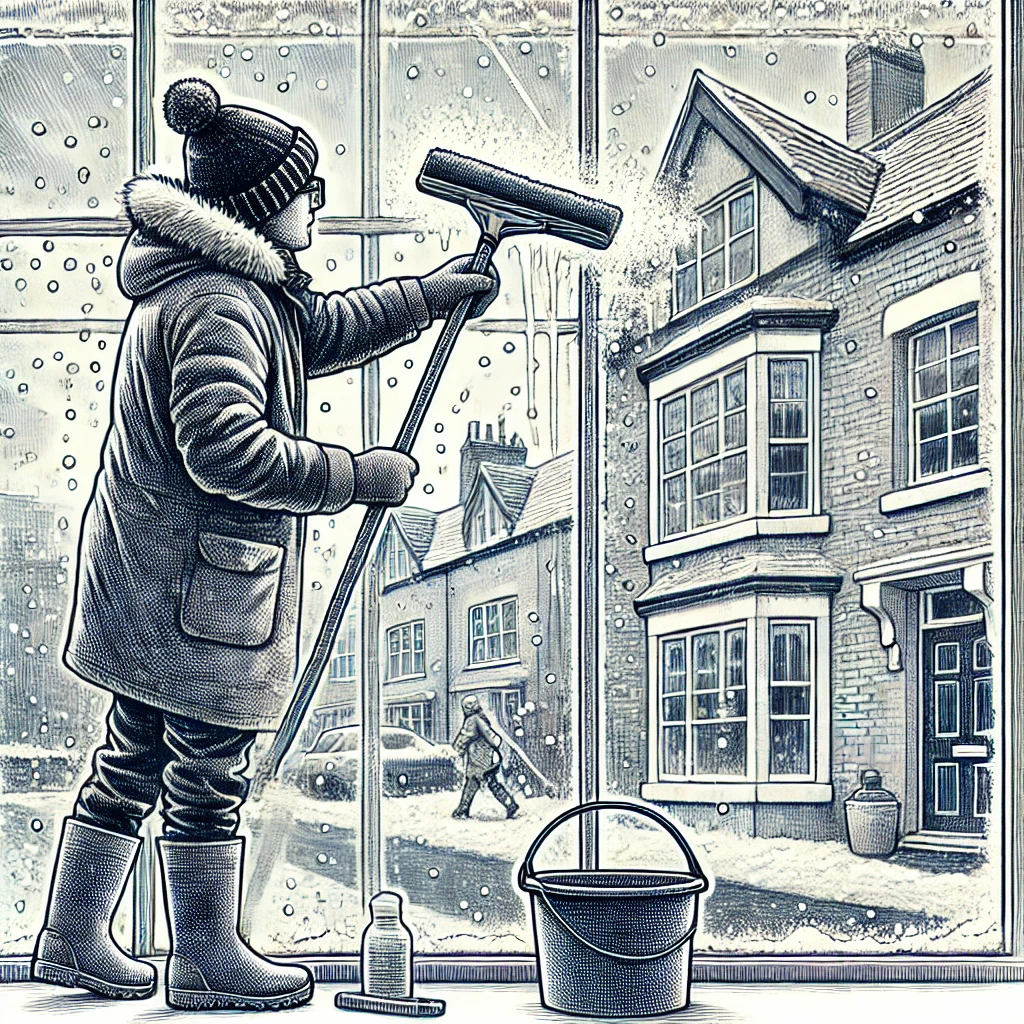
A drawing of a person washing windows during the winter

The Risks of Cleaning Windows in Winter

Winter window cleaning comes with its fair share of hazards, and taking them seriously is crucial. One of the most obvious risks is slipping. Wet, icy surfaces make ladders and ground-level work treacherous. A simple job can become a dangerous accident if you’re not careful. Even with the right footwear, working on icy ground is risky.

Then there’s the risk of freezing water. If temperatures are near zero, the water you’re using can freeze on the glass, making cleaning ineffective and potentially causing damage. Rapid temperature changes—like using warm water on cold glass—can also increase the risk of cracks, particularly if the window has pre-existing weaknesses.

Skin exposure to cold water can also be a problem. Under proper gloves, prolonged contact with water in freezing conditions can lead to numbness or mild frostbite. The cold can also make it harder to grip cleaning tools properly, leading to potential mishaps.

Another risk is streaking. Cold air affects how quickly water evaporates, making it harder to achieve a spotless finish. Without the right technique, winter window cleaning can leave your windows looking worse than before. Streaks, smudges, and cloudy patches can form if cleaning products freeze too quickly or don’t dry evenly.

The Biggest Challenges of Winter Window Cleaning

Beyond the weather, winter presents additional obstacles when cleaning windows.

1. Shorter Daylight Hours—With daylight fading as early as 4 p.m. in some parts of the UK, there’s less time to get the job done. If you don’t plan properly, you might finish in poor light, making it hard to check for streaks or missed spots.

2. Cleaning Supplies React Differently in the Cold – Some traditional cleaning solutions don’t perform well in low temperatures. Water can freeze, and some detergents leave a cloudy residue on the glass when exposed to cold air. Alcohol-based or winter-grade window cleaning solutions work better in these conditions.

3. Reaching Windows Safely – If you usually use an extendable pole or ladder, winter conditions make them trickier to handle. Windy weather can destabilise equipment, while icy ground increases the chance of slipping.

4. Drying Windows in Cold Air— Properly drying windows is essential to avoid streaks. In warm weather, water evaporates quickly, but in winter, it lingers. Using the wrong cloth or squeegee technique can worsen things, leaving smears and spots behind.

5. Dealing with Salt and Road Grime – In urban areas, winter grime isn’t just dirt—it’s a mixture of salt, road grit, and pollution. This combination can be more stubborn to remove than regular dust and rain spots, requiring stronger cleaning agents.

Professional Tips for Cleaning Windows in Winter

If you’ve decided to go ahead with winter window cleaning, there are ways to make it safer and more effective. Here are some professional tips to ensure you get the best results:

Use Cold or Lukewarm Water

Avoid using hot water on icy windows. The sudden temperature difference can cause the glass to crack. Lukewarm water mixed with a small amount of alcohol can help prevent freezing while still cutting through dirt.

Choose the Right Cleaning Solution

Some cleaning products work better in cold weather. Adding a little vinegar or rubbing alcohol to your solution can help prevent water from freezing before you can wipe it away.

Work in the Middle of the Day

Aim to clean your windows between late morning and early afternoon when temperatures are at their highest. This reduces the risk of water freezing on the glass or dangerously slippery pathways.

Use Proper Equipment

A high-quality squeegee is essential for achieving streak-free windows. Microfibre cloths are also excellent for drying without leaving lint behind. If using a pole system, ensure it’s secure and suitable for cold conditions.

Consider Protective Gear

Thermal, waterproof gloves and non-slip boots make a big difference in comfort and safety. Proper winter clothing prevents you from getting too cold while working.

Consider Professional Help

Hiring a professional can be a smart option if winter window cleaning feels like too much hassle. Experienced window cleaners have the right tools and know how to work safely in colder conditions.

Final Thoughts: Is Winter Window Cleaning Worth It?

Cleaning your windows in winter isn’t always necessary, but in some cases, it’s well worth doing. If your windows are covered in grime, letting dirt build up until spring can make them harder to clean and cause long-term damage. Clean windows allow more light into your home, brightening dark winter days. However, winter cleaning does come with risks, from slipping on icy surfaces to dealing with freezing water. If conditions seem too risky, waiting until spring or calling in a professional might be the best course.

What Is The Safest Way To Wash Upper-floor House Windows

Window Cleaning Buzz

Cleaning upper-floor house windows can feel daunting, but with the right tools, techniques, and safety measures, it doesn’t have to be.

This guide covers everything you need to know, from essential equipment to ensure a spotless finish. Explore traditional and modern washing methods, discover effective cleaning tips, and learn how to maintain your windows for lasting clarity. Get ready to make your upper-floor windows sparkle safely and efficiently!

How To Approach Upper-floor Window Washing

Understanding the importance of window safety and maintenance is crucial for homeowners, especially when it comes to managing exterior and upper-floor windows. Regular inspections and the proper cleaning techniques keep your home looking great and ensure your windows remain functional and safe.

By committing to window maintenance, you are protecting your investment and minimising risks related to falls or accidents, especially if you are up on a ladder.

Moreover, conducting routine checks for issues such as cracks in the glass, faulty locks, or deteriorating frames can significantly enhance safety. Taking proactive steps to address these concerns does not just prolong the lifespan of your windows; it also improves energy efficiency, helping to reduce those utility bills.

Do not forget about safety features like window guards; they can add a layer of protection for your little ones. By prioritising window upkeep and integrating regular maintenance practices, you can create a safer home environment, helping to prevent injuries and providing your whole family with peace of mind.

Tools and Materials Needed

To achieve a streak-free finish when washing your windows, you need the right tools and materials to keep things efficient and safe.

Think squeegees, microfibre cloths, and eco-friendly cleaners—the right cleaning products make all the difference, especially for those tricky second-floor windows.

And don’t forget about safety! Proper equipment, such as safety harnesses and sturdy ladders, will help you avoid nasty falls.

Essential Equipment for Safe and Effective Cleaning

The right equipment is essential for your safety and effectiveness when washing windows, especially when tackling high-rise buildings or those tricky spots. You’ll want to grab essential tools like a squeegee, microfibre cloths, and eco-friendly cleaning solutions to achieve that spotless shine without any streaks.

A safety harness and a telescopic pole for those upper-floor windows will seriously enhance your window cleaning efforts, giving you extra stability and reach.

Remember other must-haves, like a bucket for mixing your cleaning solutions and a scrubber or applicator for spreading the liquid evenly across the glass. A reliable ladder can be crucial for safely reaching those lower sections, and gloves will protect your hands from harsh chemicals.

Plus, a window cleaning scraper is your best friend for tackling stubborn debris, ensuring every pane sparkles.

Each tool you use plays a specific role in ensuring you clean thoroughly and remain safe while working. This ensures you can get the job done more efficiently and effectively.

Preparation and Safety Measures

Before you embark on your window cleaning adventure, it is crucial to assess the risks and take safety precautions. Consider the type of windows you’ll tackle—are they outdoor, second-floor, or high-rise?

You’ll want to grab the proper safety gear, such as ladders or elevated platforms, to keep those at bay. Additionally, getting to know your local safety regulations will ensure your cleaning efforts are effective and above board.

Steps to Ensure Safety Before Starting

Ensuring your safety before diving into window cleaning, especially for those upper-floor or high-rise windows, involves a few crucial steps. Check out the access points to your windows and consider the best ladder options to reduce the risk of falls. Following some essential safety guidelines and incorporating effective cleaning tips can make your cleaning environment safer and more efficient, allowing you to focus on that elusive streak-free finish.

First, ensure you wear the proper personal protective equipment—think of non-slip footwear and gloves. They’ll give you a secure grip while climbing and cleaning.

Next, always inspect your ladder before you get on it. Ensure it’s stable and positioned on level ground for maximum support. If you’re using specialised gear like harnesses or scaffolds, familiarise yourself with how to operate them correctly.

Don’t forget to check the weather; avoid cleaning on windy or rainy days—nobody wants to take a tumble because of a gust of wind. Finally, opt for environmentally safe and effective cleaning solutions. That way, you can achieve a clean finish without risking yourself or your surroundings.

Methods for Washing Upper-floor House Windows

Knowing and using different cleaning techniques can elevate your effectiveness and safety when washing those upper-floor house windows.

You could take the traditional route with a squeegee and a bucket or get more high-tech tools like pressure washers and hose attachments. Even window-cleaning apps can help you schedule and track how often you clean.

Each method has its advantages, depending on what type of windows you have and how easy they are to reach.

Traditional vs. Modern Techniques

Regarding cleaning windows, you can reach for a squeegee and a microfibre cloth, paired with a good glass cleaner, to achieve that streak-free shine. But have you considered modern techniques? They’re all about using advanced cleaning methods, including eco-friendly cleaners and specialised equipment designed to make your life easier and more efficient.

Certainly, traditional methods have their charm and simplicity, but modern approaches are stepping things up with impressive technology, like automated window cleaning robots and water-fed pole systems. These innovations make the process smoother and reduce the use of chemicals, which is great if you’re trying to be more environmentally conscious. That said, traditional techniques can still excel when tackling stubborn stains.

Ultimately, knowing your cleaning options helps you weigh factors like budget, window accessibility, and environmental impact. This way, you can choose the best cleaning method that perfectly fits your needs.

Tips and Tricks for a Successful Cleaning

To ensure a successful window cleaning experience, a few effective tips and tricks can streamline the process and enhance your results. Start by creating a detailed cleaning checklist, and consider adopting some time-saving techniques to tackle internal and external windows more efficiently.

Remember to use cleaning innovations, such as specialised products or tools, which can transform your house cleaning routine.

Expert Advice for a Spotless Finish

Achieving a spotless finish when cleaning your windows often means seeking expert advice from professional cleaners who know the ins and outs of effective cleaning. Following their recommended cleaning frequencies and seasonal schedules, you can keep your windows pristine. Engaging with the cleaning community online is another excellent way to pick up updated techniques and tips to enhance your approach.

Don’t overlook community resources like local workshops or instructional videos; they can provide practical demonstrations that clarify best practices. Regarding tools, experts often recommend squeegees, microfibre cloths, and eco-friendly cleaners. These align with sustainable cleaning methods and ensure a streak-free shine.

And don’t hesitate to seek advice from seasoned professionals. They can provide tailored strategies based on your specific window types, elevating your cleaning game and giving you that satisfying sense of accomplishment with each sparkling pane.

Maintenance and Prevention

Keeping your windows clean and preventing dirt build-up is essential for their appearance and functionality. Adhering to a regular cleaning schedule and performing some preventative maintenance can reduce the necessity for those deep cleaning sessions later.

Furthermore, using the appropriate window coverings can help prevent dust and dirt from accumulating. Regularly removing debris will also ensure your home always looks its best.

How to Keep Your Windows Clean and Safe in the Future

Establishing a cleaning schedule is key to keeping your windows spotlessly clean and safe in the long run. By blending domestic cleaning practices with safety protocols, you can maximise access to your windows without cutting corners on safety. Furthermore, considering the environmental impact of your cleaning products and maintaining the appropriate cleaning insurance will give you peace of mind as you tackle those future cleaning tasks.

To create an effective window cleaning routine, consider your local weather conditions—they can influence how often you need to clean. It’s best to schedule this chore during dry seasons to avoid those pesky streaks from rain.

Opt for eco-friendly cleaning solutions like vinegar or natural soaps to avoid harmful chemicals and reduce your environmental footprint. Also, remember to invest in a sturdy ladder and proper harnesses; safety is crucial when cleaning high or hard-to-reach windows.

Make it a point to review and adjust your cleaning schedule regularly based on seasonal changes. This will ensure your windows stay pristine while protecting your home and the planet.

How to Keep Sash Windows Looking Their Best

Window Cleaning Buzz

Sash windows are a classic architectural feature, adding charm and character to homes. Maintaining their beauty and functionality requires regular care.

This guide explores essential tips for cleaning, refinishing, and repairing your sash windows to keep them looking pristine. It will also discuss how to prevent common issues like weather damage and pests, improve energy efficiency, and consider upgrading to modern options. Whether you’re a seasoned homeowner or new to sash windows, these insights will help you preserve their timeless appeal.

What are Sash Windows?

What are Sash Windows?

The sash windows are rather splendid. They feature movable panels or ‘sashes’ that slide vertically or horizontally to open. You’ve probably noticed that these windows are celebrated for their historical value and architectural significance, adding a lovely touch to your home’s aesthetic.

Often made from wood, sash windows combine functionality with beauty, making them popular in traditional and modern houses. They enhance the premise’s appeal and assist with ventilation and light control.

Dating back to the 17th century, these windows showcase exceptional craftsmanship and provide a glimpse into the design integrity of their time. Typically constructed from durable materials like timber, sash windows can incorporate modern composites for longevity.

They fit beautifully with various architectural styles, from classic Victorian to sleek contemporary designs. This versatility is why they are an appealing choice for homeowners today. Furthermore, their ability to blend with different aesthetics while being energy-efficient speaks volumes about their enduring charm and practicality.

Maintaining the Appearance of Sash Windows

Keeping your sash windows looking good is key to their beauty and longevity. Regular maintenance helps preserve their charm and functionality, which boosts your home’s curb appeal.

This means routine cleaning, refinishing, and restoration techniques to keep those windows in tip-top shape while avoiding problems like rot and damage.

Depending on how your windows are holding up and how hands-on you want to be, you can tackle the maintenance yourself with DIY methods or call in the professionals.

Cleaning and Refinishing

Cleaning and Refinishing

Cleaning and refinishing your sash windows is crucial for keeping them looking great and lasting long. It’s all about maintaining their charm and ensuring they enhance your home’s aesthetic. Regular cleaning helps you avoid that pesky dirt build-up while refinishing methods like varnishing and polishing protect the wood from the elements and moisture.

But don’t stop there! Exploring different wood treatments can boost the longevity of those elegant windows. For example, a high-quality exterior varnish creates a strong barrier against UV rays, which helps prevent discolouration and warping.

Consider using eco-friendly cleaning products that clean and condition the wood, giving it a nourishing touch and a subtle shine. Soft-bristle brushes are your best friend when removing grime—they’ll tackle those crevices without scratching the surface.

By consistently following these maintenance tips, you can preserve the charm and functionality of your sash windows, which will make a noticeable difference in your home’s exterior appeal.

Repairing Damage

Repairing damage to your sash windows is essential for keeping them functional and looking good, especially when preventing rot and maintaining hardware. You might encounter common issues such as worn-out sash cords, damaged window locks, or falling-apart glazing, all of which can compromise the integrity of your windows. Regularly inspecting and addressing these minor repairs promptly will extend your windows’ lifespan and help maintain their historical charm and curb appeal.

Timely interventions can prevent more extensive and costly repairs in the future. Look for signs such as draughts, condensation between panes, or wood that feels spongy—these could indicate deeper problems.

Remember that gentle cleaning of hardware components can help prevent deterioration. When repairs are necessary, proper techniques, such as replacing damaged cords or applying protective coatings, will help ensure your windows last longer.

By being proactive about maintenance, you will preserve your property’s character and enhance its energy efficiency and overall value.

Preventing Common Issues with Sash Windows

Preventing Common Issues with Sash Windows

Preventing common issues with your sash windows is crucial for keeping them performing well and looking great. By prioritising weatherproofing and insulation, you can shield your sash windows from the elements, which helps prolong their lifespan and cut down on those expensive repairs.

This proactive approach boosts energy efficiency and keeps the historical charm and curb appeal intact. Plus, making it a habit to inspect and maintain them regularly helps spot any potential problems before they turn into bigger headaches.

Weatherproofing and Insulation

Weatherproofing and insulation are essential for keeping your sash windows in tip-top condition. They significantly affect your home’s energy efficiency and overall comfort. Proper weatherproofing techniques—such as sealing pesky gaps and applying weatherstripping— keep drafts and moisture at bay, making your indoor space feel cosy and inviting.

Moreover, improving insulation boosts energy savings and helps reduce noise, providing a quieter living environment.

If you incorporate methods like foam insulation and weather-resistant coatings, you can significantly improve the durability and performance of your windows. These strategies work wonders to minimise thermal bridging and moisture buildup, which can cause serious long-term damage.

Investing in quality materials for insulation and weatherproofing can be a game-changer, drastically lowering your heating and cooling costs. And don’t forget about ventilation solutions; they help manage indoor air quality and prevent condensation from becoming a problem.

A comprehensive approach to maintaining your sash windows makes your space more comfortable and supports sustainability by reducing overall energy consumption.

Dealing with Pests and Rot

Dealing with pests and rot is key to keeping your sash windows in tip-top condition, especially if you’re working with older structures where historical accuracy matters. Regular maintenance helps prevent pest infestations that could compromise the timber, and using the right wood treatment methods can protect against rot. By being proactive in these areas, you preserve the beauty and functionality of your sash windows and maintain their historical and architectural value.

Make it a point to Conduct thorough inspections at least once a year, focusing on joints and areas prone to moisture. Using specialised wood preservatives compatible with historical materials can help ensure your restoration efforts stay true to the original design while providing the protection you need. Sealing cracks and crevices create a barrier against pests, prolonging your windows’ life.

By emphasising these preventive measures, you contribute significantly to the longevity of sash windows and honour their historical significance, ensuring that future generations can appreciate their unique charm.

Improving Energy Efficiency of Sash Windows

Improving the energy efficiency of your sash windows can increase energy savings and create a more comfortable home environment. Upgrading to double glazing or enhancing your insulation methods can drastically reduce heat loss and make your home more energy-efficient.

This will help lower your energy bills and support sustainability and environmental efforts, making it a key part of modern home improvement.

Options for Energy-Efficient Sash Windows

When you’re looking for energy-efficient sash windows, you have a few great options to consider. Double glazing is a significant option—it reduces heat loss and boosts insulation, making your home cosier. Upgrading the hardware can also make a noticeable difference, enhancing functionality while reducing noise and overall discomfort.

These modern updates increase energy efficiency and keep those windows sharp and aligned with sustainable practices.

Also, check out advanced glazing solutions, such as low-emissivity (Low-E) glass, reflecting heat into your home while letting in that lovely natural light. Additionally, improving your hardware with modern balances and weatherstripping can make your windows easier to use and keep those annoying draughts at bay.

It’s all about finding the right balance between these energy-efficient upgrades and the classic charm of sash windows. You want to preserve your home’s character while still enjoying the advantages of modern technology.

Upgrading to Modern Sash Windows

Upgrading to modern sash windows can bring many benefits, such as improved energy efficiency and enhanced functionality while preserving your property’s historic charm.

These upgrades typically feature advanced materials and craftsmanship that maintain that classic appearance you love while incorporating some modern conveniences.

You can enjoy the best of both worlds—elegant design and practical performance.

Benefits and Considerations

Upgrading to modern sash windows has some great benefits, such as improved energy efficiency, increased durability, and the opportunity to preserve your home’s historic charm. While these modern materials often provide a performance boost, you’ll want to consider how these upgrades fit with your property’s architectural style. Finding that sweet spot between modern enhancements and traditional features can enhance your curb appeal while keeping things functional.

This is especially important if your property is in a conservation area or has listed status, where adhering to the original design elements matters. Modern sash windows typically have better insulation and require less maintenance, making them a practical choice for many homeowners.

Selecting products that complement your building’s existing style and character is crucial. Mismatched features can disrupt the whole aesthetic. By focusing on performance and historical accuracy, you can enjoy the benefits of modern innovations while honouring your home’s legacy.

Kindergarten Window Cleaning

Window Cleaning Buzz

Hello, my fellow window-cleaning nerds and connoisseurs! My name is Peter Trent, and I am a South West London-based window cleaner with over fifteen years of professional experience. A few friends and colleagues have encouraged me to share what I’ve learned and seen – to pass the knowledge, so to speak. But I will start my blog with a fairly recent personal and funny story that reminded me why I love my job.

My wife and I enrolled our four-year-old son Alex in one of the best kindergartens in Battersea. He quickly adjusted to this new adventure and found many new friends while his Mom could reignite her career as an interior designer. We were very happy with our choice – the location was a fifteen-minute walk away from home, close to an awesome park where the kids could play and featuring an excellent staff of energetic and sunny professionals.

Ecstatic as we were, ask any parent what their nightmare scenario is, and nine out of ten will tell you it’s a call from their children’s school or kindergarten. I had just finished a regular domestic window cleaning job at Cambridge Road in Battersea when Alex’s kindergarten number appeared on my phone screen. I admit I froze in my place. If there was a problem, the principal or teachers usually called the kid’s mother. So the issue was either critical, or they could not get in touch with my wife. Either way, I picked up in near panic.

“Hello, is this Mr Trent? My name is Anne Smith, and I am the principal at your son’s kindergarten.”

There was no trace of worry or concern in her voice, which calmed me down a bit. “Is everything OK?”

“Oh, everything is fine. I am really sorry to bother you about such a nuisance. In fact, I am not calling you as Alex’s father but in your professional capacity. You may not remember, but we ask all parents to submit entry forms that include their profession, and yours says you are a window cleaner. Is that correct?”

“Yes”, I responded in a much calmer voice, already guessing where this was going.

“We would like to book you for a specific job – interior window cleaning, two large rectangular panes. However, the task is a bit more specific. I can send you pictures to illustrate what I mean.”

Thirty seconds later, I received an email with two photos. Oh my, that was going to be a specific case! The windows in question were perfectly standard in size and shape – I had cleaned thousands of them in my practice. However, their bottom half was covered in all sorts of surrealistic figures, representing stylized animals, houses, and futuristic landscapes. I could guess from the pictures that the aspiring artists had used pastels for their work – permanent markers are extremely easy to remove, even by a non-professional.

Or how I removed pastel drawings from the windows.

I called my wife and told her the whole story, saying I would be picking Alex up today. She killed me with her initial reaction: “Why are they cleaning the windows? I’m sure they look pretty cool!” I should not have expected anything else from an interior designer.

It was still the early afternoon, so I had no reason to hurry. I stopped at Flour to the People Pizza at Battersea Park Rd for an Antonio pizza, then headed to the kindergarten. The principal was already waiting for me at the front door and showed me in.

Parents usually waited for their kids at the door, so this might have been the first time I stepped into the premises. As a professional cleaner, I could see that the staff kept the rooms in perfect order – which was commendable with a bunch of wild monkeys running around.

“We try to encourage the creative expression of all kids, as you can see. We have put two large whiteboards where they can draw anything they want. But I don’t have to tell you how children at this age love breaking the rules – so the windows became an extension of the boards”, explained Mrs Smith. “Permanent markers are not a problem – we do not even need a detergent to wash them away. Pastels are a different kind of problem altogether.”

“Have you tried an all-purpose cleaner?”

“Here is the thing – we try to limit the application of detergents as much as possible. Some children have respiratory problems and allergies, and their parents insist on natural cleaning products. Would that be a problem?”

“It shouldn’t be. Would it be OK to use regular dish soap?”

“For the windows?!” Mrs Smith looked at me incredulously.

“You would be surprised at the applications of everyday cleaning stuff”, I said reassuringly. I asked for a small bucket, filled it with warm water, and added some dish soap. An older colleague had shown me the trick for removing rust around metal window frames, and I saw no reason why it should not work on pastels. Instead of a squeegee, I planned to use a microfibre cloth and apply the soapy solution to the glass. Tip number two – I knew circular motion worked wonders instead of the simple up-down or left-right rubbing. Within seconds, the first pastel shapes began to come off the pane. It was a time-consuming job because of the square footage, but half an hour later, the windows were polished to a perfect shine.

All throughout the process, the few remaining kids in the room had observed my work with growing interest. If there was ever disappointment that their art was being removed, they did not show it – Alex and his best friend Victor even wanted to help. “You could employ them for the next cleaning job”, I jokingly suggested to Mrs Smith, who definitely enjoyed the idea.

At dinner, Alex officially announced that he wanted to be a window cleaner when he grew up. I am not sure his mother was amused.